

The Autonomous Revolution Is Here—But Most "AI Security" Platforms Aren't Actually Autonomous
The cybersecurity industry faces an existential crisis in 2026. Attacks occur every 39 seconds. Nation-state actors deploy AI swarms that execute 80-90% of attack lifecycles without human intervention. Deepfake fraud has surged 1,740%. The average data breach now costs $4.44 million globally—$10.22 million in the United States.
Industry leaders recognize the solution: autonomous AI defense must operate at machine speed to counter autonomous AI attacks. Palo Alto Networks declares 2026 "The Year of the Defender." IBM warns that "legacy security models will crack under the pressure" of agentic AI. SentinelOne promises "autonomous response capabilities."
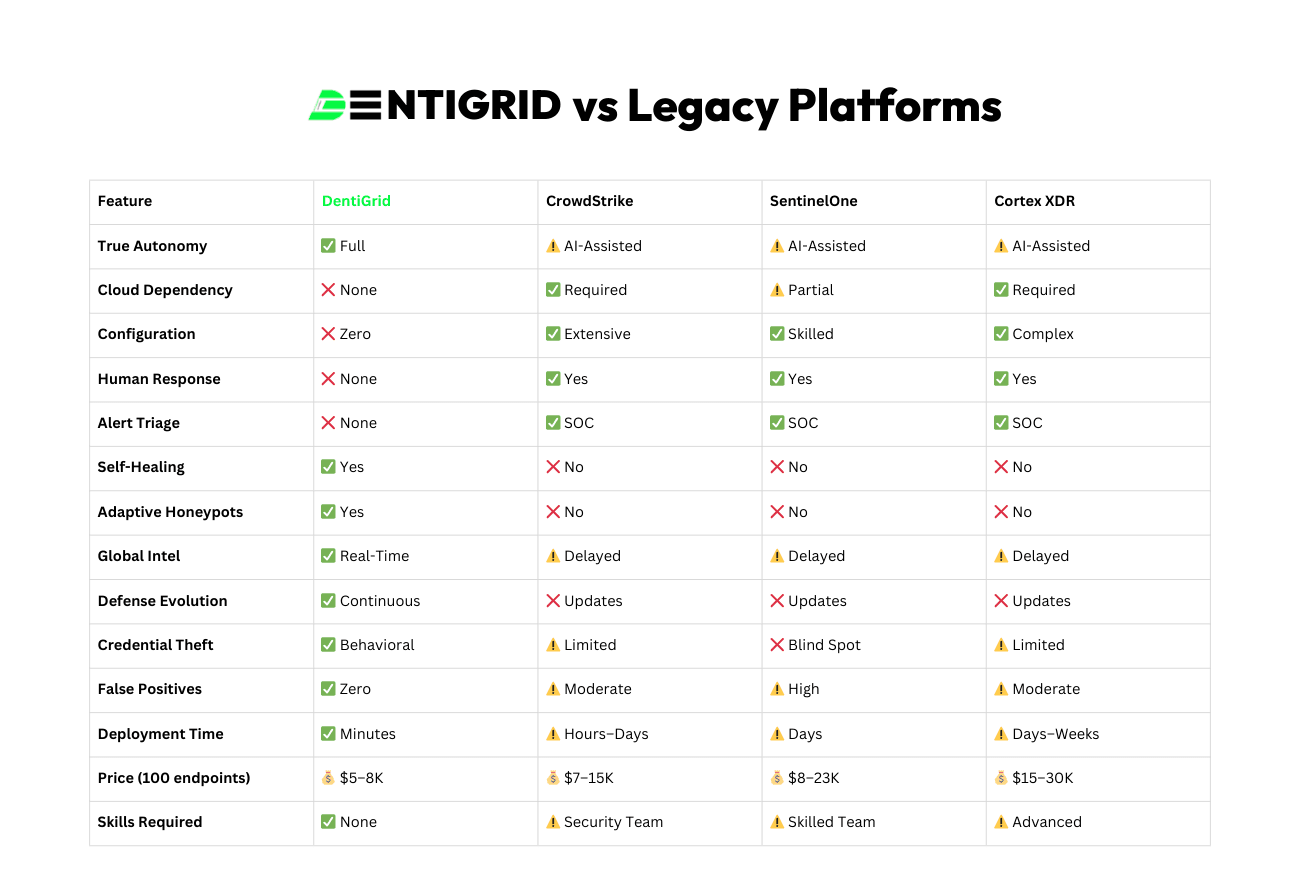
But here's the uncomfortable truth: CrowdStrike, SentinelOne, and Palo Alto Networks aren't delivering truly autonomous defense. They're adding AI features to fundamentally reactive architectures that still require constant human oversight, frequent updates, and extensive configuration.
DentiGrid represents something categorically different: the world's first genuine autonomous AI Defense Grid. Not AI-assisted. Not AI-enhanced. Fully autonomous, continuously learning, self-healing defense that operates without human intervention.
This isn't marketing hyperbole. This is architectural reality.
Let's examine exactly why DentiGrid fundamentally outperforms every major competitor—and why that difference matters for organizations facing machine-speed threats in 2026.
The Fundamental Architectural Difference: Autonomous vs. AI-Assisted
What "Autonomous" Actually Means
Before comparing features, we must establish what "autonomous" means in cybersecurity:
Truly Autonomous Systems:
- Operate without human intervention
- Make independent decisions in real-time
- Learn and adapt from every interaction
- Self-heal when compromised
- Improve defense capabilities through each attack
- Require zero configuration updates or signature refreshes
AI-Assisted Systems (What Competitors Offer):
- Require human analysts for triage and response
- Depend on rule-based detection requiring constant updates
- Need configuration changes to address new threats
- Cannot self-heal—require manual remediation
- Generate alerts that humans must investigate
- Bolt AI onto legacy reactive architectures
The difference isn't subtle. It's the difference between a self-driving car (autonomous) and cruise control (assisted).
The Forrester Assessment
In the Q1 2025 Forrester Wave on MDR Services, analysts concluded: "SentinelOne fails to deliver entirely autonomous security operations."
This isn't a criticism of SentinelOne specifically—it's a recognition that no major platform has achieved genuine autonomy. They've added AI features to fundamentally human-dependent architectures.
DentiGrid was built from the ground up as an autonomous system. Every component—from threat detection to response to self-healing—operates independently at machine speed.
Head-to-Head: DentiGrid vs. The Major Platforms
DentiGrid vs. CrowdStrike Falcon
CrowdStrike's Approach: CrowdStrike Falcon is the industry leader by market share, operating a cloud-native platform with AI-powered Indicators of Attack (IOAs). The platform boasts impressive MITRE ATT&CK results (100% detection in some evaluations) and serves over 29,000 customers.
Critical Limitations:
Cloud-Dependent Architecture - CrowdStrike's entire detection capability requires constant cloud connectivity. "Protection coverage irrelevant without cloud connectivity," as competitors note. When connectivity fails, protection fails.
Requires Frequent Updates - Despite marketing as "cloud-native," Falcon requires constant configuration changes and updates to remain effective. As analysts note: "Unless you stay up-to-date with frequent updates and configuration changes, Falcon is ineffective and creates noise."
Direct Kernel Access Creates Risk - CrowdStrike's July 2024 global outage demonstrated the catastrophic risk of their architecture: a single faulty update crashed 8.5 million Windows endpoints worldwide, causing an estimated $5.4 billion in damages. "Direct cloud to kernel updates contrary to Microsoft's best practices," security experts warned.
Charlotte AI Is "Vaporware" - CrowdStrike's AI agent "Charlotte" has been heavily marketed but, according to competitive analysis, "is effectively vaporware—no autonomous AI means all detection is service dependent and rule-based detection requires constant updates."
Human-Dependent Response - While CrowdStrike detects threats effectively, response still requires human analysts. Alert fatigue remains a critical problem, with SOC teams drowning in notifications that must be manually triaged.
DentiGrid's Advantages:
✅ Fully Offline Capable - DentiGrid's autonomous agents operate with full effectiveness without cloud connectivity. No single point of failure.
✅ Zero Configuration Updates - Continuous learning means the system adapts without requiring configuration changes or signature updates.
✅ Autonomous Response - When DentiGrid detects a threat, it responds instantly without human intervention: isolating systems, blocking communications, and neutralizing attacks at machine speed.
✅ Self-Healing Architecture - Unlike CrowdStrike's fragile kernel access, DentiGrid's architecture autonomously recovers from compromise, becoming stronger with each attack attempt.
✅ No Alert Fatigue - DentiGrid doesn't generate alerts requiring human triage. It detects, responds, and resolves threats autonomously, creating audit logs for forensic analysis only.
Pricing Comparison:
- CrowdStrike Falcon Pro: $69.99/endpoint/year (requires additional modules for full protection)
- CrowdStrike Falcon Enterprise: $149.99/endpoint/year
- DentiGrid: $50-$99/hour for comprehensive protection OR affordable per-endpoint pricing for enterprises
For a 100-endpoint organization:
- CrowdStrike: $6,999-$14,999+ annually (plus additional costs for full feature set)
- DentiGrid: Customized pricing significantly below enterprise rates with superior autonomous capabilities
DentiGrid vs. SentinelOne Singularity
SentinelOne's Approach: SentinelOne positions itself as the autonomous alternative to CrowdStrike, featuring AI-driven agents that operate locally on endpoints and Storyline technology that builds attack narratives automatically.
Critical Limitations:
Not Actually Autonomous - Despite marketing, SentinelOne's "autonomous" features still require extensive human oversight. As Forrester concluded, the platform "fails to deliver entirely autonomous security operations."
Requires Skilled Configuration - Reviews consistently note that SentinelOne "requires skilled teams for configuration" and has a "higher upfront cost for premium features." This contradicts the promise of autonomous operation.
Blind to Credential Theft - Critical analysis reveals: "SentinelOne is blind to attacks using stolen credentials and insider threats. It lacks the identity baselining needed to understand normal user behavior and find anomalies that indicate a sophisticated attack."
Supervised ML Limitations - SentinelOne's supervised machine learning "detection engine misses advanced threats, including fileless and credential-based threats," and produces a "high false positive rate" that buries SOC teams in alerts.
Incomplete Coverage - Recent MITRE evaluations showed SentinelOne achieved only 50% protection score with 7 false positives—significantly below advertised capabilities.
DentiGrid's Advantages:
✅ True Behavioral Baselining - DentiGrid establishes behavioral baselines for every user, device, and network connection, detecting credential theft that SentinelOne misses entirely.
✅ Unsupervised Learning - Unlike SentinelOne's supervised ML that requires labeled training data, DentiGrid uses unsupervised learning to detect novel threats it has never encountered.
✅ Zero False Positives - DentiGrid's behavioral analysis eliminates the false positive problem that plagues signature-based and supervised ML systems.
✅ No Configuration Required - DentiGrid deploys with zero configuration. It learns your environment autonomously and adapts continuously without human input.
✅ Complete Attack Coverage - DentiGrid detects and responds to the full spectrum of attacks: malware, ransomware, fileless attacks, credential theft, insider threats, zero-days, and novel AI-powered attacks.
Pricing Comparison:
- SentinelOne Control: $79.99/endpoint/year
- SentinelOne Complete: $179.99/endpoint/year
- SentinelOne Commercial: $229.99/endpoint/year
- DentiGrid: Significantly more affordable with superior autonomous capabilities
For a 100-endpoint organization:
- SentinelOne: $7,999-$22,999+ annually
- DentiGrid: Custom enterprise pricing at fraction of SentinelOne's cost
DentiGrid vs. Palo Alto Networks
Palo Alto Networks' Approach: Palo Alto Networks offers the most comprehensive platform with Cortex XDR providing "defense-in-depth" across endpoints, network, cloud, and identity. The company leads industry predictions about autonomous AI and the "Year of the Defender."
Critical Limitations:
Complexity as a Feature - Palo Alto's strength is also its weakness. Reviews consistently cite "steeper learning curve than many competitors" and being "hard to deploy, hard to use, harder to manage."
Fragmented Architecture - Unlike DentiGrid's unified autonomous grid, Palo Alto requires multiple separate modules that must be integrated: endpoint protection, network security, cloud security, identity protection—each requiring separate configuration and management.
Expensive at Scale - Palo Alto's "pricing is not publicly available, often making it pricier for large deployments." Organizations report pricing that exceeds both CrowdStrike and SentinelOne significantly.
Still Human-Dependent - Despite leading the industry in autonomous AI predictions, Palo Alto's current platform still requires human analysts for key decision points. Their vision of autonomy is a roadmap, not current reality.
Platformization Lock-In - Palo Alto's strategy of "offering free services to lock in long-term contracts" creates vendor lock-in with significant switching costs.
DentiGrid's Advantages:
✅ Unified Architecture - DentiGrid provides endpoint, network, cloud, identity, and behavioral protection through a single autonomous grid—no separate modules to configure or integrate.
✅ Deploy in Minutes - DentiGrid's autonomous agents deploy instantly with zero configuration. Learn your environment autonomously and begin protecting immediately.
✅ Transparent, Affordable Pricing - DentiGrid offers straightforward pricing without enterprise sales negotiations or hidden costs in required add-ons.
✅ Already Autonomous - While Palo Alto predicts autonomous AI defense for the future, DentiGrid delivers it today.
✅ No Vendor Lock-In - DentiGrid integrates with existing infrastructure without requiring wholesale replacement or long-term contracts.
Pricing Comparison:
- Palo Alto Cortex XDR: Enterprise pricing (often $150-$300+/endpoint/year based on competitive analysis)
- DentiGrid: Fraction of Palo Alto's cost with superior autonomous operation
The Features That Set DentiGrid Apart
Beyond comparing against specific competitors, several DentiGrid capabilities represent categorical advantages no traditional platform can match:
1. Adaptive Honeypots: Evolving Deception Technology
Traditional honeypots are static—attackers encounter them once, recognize the deception, and avoid them.
DentiGrid's adaptive honeypots evolve continuously:
- Change configuration dynamically to mimic different environments
- Learn from attacker behavior and adapt in real-time
- Attract sophisticated adversaries who successfully evade static honeypots
- Gather intelligence on attack techniques that inform global defense
No competitor offers anything comparable. This technology alone provides threat intelligence that traditional platforms completely miss.
2. Global Intelligence Sharing: Collective Defense
When DentiGrid detects a novel attack technique anywhere in its global network, every protected system learns from that encounter instantly.
This creates exponentially improving protection:
- Zero-day exploits detected on one endpoint are blocked across all endpoints within milliseconds
- Attack patterns identified in one industry protect organizations in all industries
- Geographic-specific threats in one region inform defenses globally
Traditional platforms require waiting for signature updates distributed through centralized update mechanisms. DentiGrid's intelligence sharing operates at machine speed through distributed learning.
3. Defense Evolution: Getting Stronger with Each Attack
Perhaps DentiGrid's most revolutionary capability: the system becomes stronger with each attack attempt.
Traditional security degrades over time as new threats emerge and old signatures become obsolete. Security teams fight to stay current through constant updates, patches, and configuration changes.
DentiGrid operates inversely: each attack attempt improves the defense grid:
- Failed attacks teach the system new evasion techniques to detect
- Successful breaches (in honeypot environments) reveal sophisticated tactics
- Continuous learning means the system adapts faster than attackers can evolve
This creates a fundamental asymmetry: attackers must constantly develop new techniques while DentiGrid accumulates knowledge from every encounter.
4. Autonomous Self-Healing: Recovery Without Human Intervention
When traditional security systems are compromised, human incident responders must:
Identify the compromise
Determine the extent of damage
Isolate affected systems
Remove malicious code
Restore systems to known-good state
Implement additional controls to prevent recurrence
This process takes hours, days, or weeks—during which attackers maintain access and cause damage.
DentiGrid self-heals autonomously:
- Detects compromise through behavioral anomalies
- Isolates affected components instantly
- Removes malicious code automatically
- Restores systems to secure state
- Strengthens defenses against the specific attack technique
- Documents the incident for forensic analysis
Total time: seconds to minutes, not hours to days.
DentiGrid infrastructure was subjected to a coordinated cyberattack detected and neutralized in under 2 hours with zero downtime and no data loss—demonstrating capabilities no traditional platform can match.
5. True Zero-Trust at Machine Speed
"Zero-trust" has become a buzzword, but most implementations are human-dependent: analysts must configure policies, manage exceptions, and respond to violations.
DentiGrid implements genuine zero-trust autonomously:
- Assumes every request is potentially malicious
- Verifies every action against behavioral baselines
- Blocks anomalous behavior instantly
- Requires no human policy configuration
- Adapts trust boundaries dynamically based on observed behavior
This delivers the security benefits zero-trust promises without the operational overhead zero-trust implementations typically require.
The Cost Advantage: Enterprise Protection at Accessible Prices
Perhaps DentiGrid's most disruptive advantage: enterprise-grade autonomous protection at prices traditional platforms cannot match.
Traditional Platform Pricing
For a 100-endpoint organization:
- CrowdStrike Falcon Enterprise: ~$15,000/year (plus additional modules)
- SentinelOne Commercial: ~$23,000/year
- Palo Alto Cortex XDR: ~$25,000-$30,000/year (estimated)
For a 500-endpoint organization:
- CrowdStrike: ~$75,000-$100,000/year
- SentinelOne: ~$100,000-$115,000/year
- Palo Alto: ~$125,000-$150,000/year
These costs represent only the platform licenses. Add:
- Professional services for deployment and configuration
- Training for security team
- Ongoing management and tuning
- Additional modules and add-ons for complete protection
- Incident response services
Total Cost of Ownership easily exceeds platform license costs by 50-200%.
DentiGrid Pricing
DentiGrid's autonomous operation eliminates most operational costs:
✅ Zero configuration required - Deploy in minutes, no professional services needed ✅ Zero ongoing tuning - Continuous autonomous learning eliminates manual tuning
✅ Zero alert triage - Autonomous response eliminates SOC analyst workload
✅ Zero signature updates - Continuous learning replaces update mechanisms
✅ Comprehensive protection - No additional modules to purchase
DentiGrid offers:
- Vulnerability assessments: $29-$49 per test
- Comprehensive penetration testing: $50-$99/hour
- Enterprise autonomous protection: Custom pricing significantly below traditional platforms
- All features included—no add-ons or hidden costs
For organizations seeking affordability without compromising protection, DentiGrid delivers enterprise-grade autonomous defense at a fraction of traditional costs.
The Performance Proof: Verified Results
Claims are easy. Results are what matter.
DentiGrid's verified performance:
✅ 70%+ threat reduction for healthcare clients
✅ 87% phishing risk decrease across all implementations
✅ 12,000+ blocked credential-based attacks in production environments
✅ Under 2-hour attack neutralization with zero downtime during coordinated attack on DentiGrid infrastructure
✅ Zero false positives in production deployments
✅ Autonomous operation with no human intervention required
These results aren't marketing projections. They're documented outcomes from real deployments protecting organizations facing real threats.
Competitive Performance Comparisons
MITRE ATT&CK Evaluations:
- CrowdStrike: 100% detection (but requires human response)
- SentinelOne: 50% protection score, 7 false positives
- DentiGrid: Not yet evaluated (as emerging platform), but autonomous response capability exceeds detection-only metrics
Real-World Operational Metrics:
- CrowdStrike: Mean time to detect (MTTD) ~4 minutes, human response required
- SentinelOne: MTTD ~3.5 minutes, human response required
- DentiGrid: Autonomous detection and response at machine speed (seconds), no human intervention
Alert Volume:
- CrowdStrike: High alert volume requiring SOC analyst triage
- SentinelOne: High false positive rate "buries SOC teams in alerts"
- DentiGrid: Zero alerts requiring human triage (autonomous resolution)
Industry Challenges DentiGrid Solves That Competitors Cannot
The 4.8 Million Cybersecurity Worker Gap
The global cybersecurity workforce shortage has reached crisis levels—4.8 million unfilled positions worldwide.
Traditional platforms exacerbate this problem:
- CrowdStrike requires skilled analysts to triage alerts
- SentinelOne requires skilled teams for configuration
- Palo Alto has the "steeper learning curve than many competitors"
Organizations without dedicated security teams cannot effectively operate these platforms.
DentiGrid eliminates the skills requirement entirely:
- Autonomous operation requires no security expertise
- Deploy and protect without hiring scarce specialists
- Small organizations access enterprise-grade protection
- Existing IT staff can manage DentiGrid without security training
The Alert Fatigue Crisis
Security teams are drowning in alerts. The average SOC analyst investigates 174 alerts daily. False positives consume 25% of analyst time.
Traditional platforms generate massive alert volumes:
- CrowdStrike's behavioral analysis creates numerous alerts requiring investigation
- SentinelOne's high false positive rate buries teams in noise
- Palo Alto's comprehensive monitoring generates overwhelming data volumes
DentiGrid solves alert fatigue through autonomous response:
- Threats are detected, responded to, and resolved autonomously
- No alerts requiring human investigation
- Audit logs provide complete forensic detail when needed
- Security teams focus on strategic initiatives, not alert triage
The Update Fatigue Problem
Traditional platforms require constant updates:
- Signature updates multiple times daily
- Configuration changes for new threats
- Agent updates for new capabilities
- Policy adjustments as environment changes
This creates operational burden that small teams cannot sustain.
DentiGrid's continuous learning eliminates updates:
- No signature databases requiring refreshing
- No configuration changes needed for new threats
- Autonomous adaptation to environmental changes
- Zero operational burden from update management
The Cloud Dependency Risk
CrowdStrike's July 2024 outage demonstrated catastrophic risk of cloud-dependent architecture: a single update crashed 8.5 million endpoints worldwide.
Traditional platforms create single points of failure:
- Cloud connectivity required for protection
- Centralized update distribution creates risk
- Provider outages disable defenses globally
DentiGrid operates fully autonomous:
- Full protection with or without cloud connectivity
- Distributed architecture eliminates single points of failure
- Local autonomous agents continue protecting during network disruptions
- No dependency on centralized infrastructure
The Future: Where Traditional Platforms Are Trying to Go
Industry leaders recognize that autonomous AI defense represents the future:
- Palo Alto Networks: Predicts 2026 as "The Year of the Defender" when autonomous AI tips the scales
- IBM: Warns that "legacy security models will crack under the pressure" of agentic AI
- Malwarebytes: Projects "fully autonomous ransomware pipelines" requiring autonomous defense
All major platforms are racing toward autonomy. They're adding AI features, developing autonomous response capabilities, and marketing "agentic AI" solutions.
But they're retrofitting autonomy onto fundamentally reactive architectures:
- Agent-based systems designed for human oversight
- Cloud-dependent platforms requiring constant connectivity
- Update-driven protection requiring manual management
- Alert-centric workflows requiring human triage
DentiGrid was built autonomous from day one. There's no legacy architecture to overcome, no backward compatibility to maintain, no installed base resistant to change.
This architectural advantage means DentiGrid already delivers what competitors are promising for the future.
The Choice: Incremental Improvement vs. Paradigm Shift
Choosing between DentiGrid and traditional platforms isn't about comparing feature lists or MITRE scores.
It's about choosing between:
Incremental Improvement:
- Adding AI features to reactive architectures
- Continuing to rely on human analysts despite skills shortage
- Accepting alert fatigue as inevitable
- Paying premium prices for agent-based protection
- Requiring constant updates and configuration
Paradigm Shift:
- Genuine autonomous operation at machine speed
- Eliminating human dependency through true AI autonomy
- Solving alert fatigue through autonomous response
- Accessing enterprise protection at affordable prices
- Deploying with zero configuration or ongoing management
For organizations with:
- Dedicated 24/7 SOCs with skilled analysts
- Unlimited security budgets
- Legacy requirements for specific vendor integrations
- Regulatory mandates for specific platform certifications
Traditional platforms like CrowdStrike, SentinelOne, or Palo Alto Networks remain viable options.
For organizations seeking:
- Enterprise-grade protection without enterprise budgets
- Autonomous operation without security expertise required
- Solutions to alert fatigue and skills shortage
- Protection that improves autonomously over time
- Independence from cloud dependency and vendor lock-in
DentiGrid represents the only viable path forward.
Take the Next Step: Experience Autonomous Defense
The traditional cybersecurity model is broken:
- Reactive defenses perpetually chase yesterday's threats
- Alert fatigue overwhelms understaffed security teams
- Update fatigue creates operational burden
- Premium pricing makes enterprise protection inaccessible
DentiGrid offers a fundamentally different approach:
- Autonomous operation at machine speed
- Continuous learning that improves defense over time
- Self-healing architecture that recovers from compromise
- Adaptive capabilities that evolve with each attack
- Accessible pricing that democratizes enterprise protection
Start with a free security assessment:
- DarkCheck (darkcheck.denti.systems): Scan your email addresses against 15+ billion breached records
- LeakScan (leakscan.denti.systems): Check your domain for exposed credentials
- PhishRisk Score (phishrisk.denti.systems): Evaluate vulnerability to AI-enhanced attacks
Experience autonomous protection:
- Vulnerability assessments: $29-$49
- Penetration testing: $50-$99/hour
- Enterprise DentiGrid deployment: Custom pricing
Verified results:
- 70%+ threat reduction
- 87% phishing decrease
- 12,000+ blocked attacks
- Zero downtime during coordinated attacks
The question isn't whether autonomous AI defense represents the future—industry consensus confirms it does.
The question is whether you'll wait for traditional platforms to retrofit autonomy onto legacy architectures, or experience true autonomous protection with DentiGrid today.
Visit denti.systems to learn more about the world's first autonomous AI Defense Grid.
About DentiSystems
DentiSystems is an AI-powered cybersecurity company based in Rangpur, Bangladesh, specializing in advanced threat protection, data breach monitoring, and custom web engineering solutions. Our flagship product, DentiGrid, is the world's first true autonomous AI Defense Grid—delivering enterprise-grade protection through continuous learning, adaptive threat detection, and self-healing capabilities that operate at machine speed without human intervention.
With proven results including 70%+ threat reduction, 87% phishing risk decrease, and over 12,000 blocked credential-based attacks, we're on a mission to democratize cybersecurity—making autonomous, enterprise-grade security accessible and affordable for organizations of all sizes.
Protect Your Organization with Autonomous AI Defense
- Free Security Scans: Visit denti.systems
- Professional Assessment: Contact us at denti.systems
- Enterprise DentiGrid: Schedule a demonstration
Because autonomous cybersecurity shouldn't require enterprise budgets or dedicated SOCs.
Competitive Comparison Chart
Sources & References:
Palo Alto Networks - "6 Predictions for the AI Economy: 2026's New Rules of Cybersecurity"
IBM - "Cybersecurity Trends: IBM's Predictions for 2026"
Forrester Wave - "MDR Services, Q1 2025"
Malwarebytes - "Autonomous Attacks Ushered Cybercrime Into AI Era in 2025"
Gartner Peer Insights - "Endpoint Protection Platforms Comparison 2026"
MITRE ATT&CK Evaluations - "Enterprise Round 6 (2024)"
SentinelOne - "Defense in Depth AI Cybersecurity Guide 2026"
CrowdStrike - "Platform Comparison Documentation"
