
Why Cybersecurity Has Become Bangladesh's Most Urgent Enterprise Priority
Bangladesh's digital economy has undergone a structural transformation over the past decade. The "Smart Bangladesh" initiative, a surge in mobile financial services (MFS) adoption, government e-governance programs, and a rapidly expanding startup ecosystem have collectively pushed the country's internet user base past 126 million — one of the fastest-growing digital populations in Asia.
This growth, however, has created an attack surface that many organizations are only beginning to understand. Bangladesh recorded a 105% surge in reported cyberattacks between Q2 and Q3 of 2024 alone. Banking institutions face an estimated 630 cyberattacks daily on average. The 2023 breach that exposed the personal data — including national ID numbers — of over 50 million citizens through government web infrastructure remains one of the most consequential data security failures in South Asian history.
Selecting the right cybersecurity companies in Bangladesh is therefore not merely a procurement decision — it is a strategic imperative that directly affects operational continuity, regulatory standing, and stakeholder trust. As the threat landscape evolves toward AI-driven attacks, state-sponsored intrusions, and large-scale ransomware campaigns, the gap between organizations with mature security partnerships and those without is widening at an accelerating rate.
This independent review evaluates the top cybersecurity companies in Bangladesh for 2026, using a structured methodology designed to give enterprise buyers, SME decision-makers, and public sector procurement teams an objective, data-grounded basis for comparison.
How We Ranked These Companies: Methodology
Every company in this review was evaluated against eight weighted criteria. This framework is based on recognized global security assessment standards, adapted for the specific demands of Bangladesh's threat environment and market maturity.
1. Technical Capability and Service Depth Does the company offer comprehensive coverage across offensive security (penetration testing, red teaming), defensive operations (SOC, SIEM, endpoint protection), and advisory services (GRC, compliance)? Organizations with narrow specialization score lower on this dimension.
2. AI and Automation Integration The shift from rule-based detection to machine learning-driven, behavioral threat detection is the defining technological transformation in cybersecurity. Companies deploying AI natively — not as a vendor-resold feature — receive higher scores.
3. Proprietary Tool Development Organizations that have invested in building their own security tools signal a deeper engineering capability and a more differentiated offering than those relying exclusively on third-party platforms.
4. Client Portfolio and Sector Coverage A diverse client portfolio across BFSI, healthcare, government, and e-commerce demonstrates adaptability and broad threat domain competence. Companies serving multiple verticals are generally more resilient in their methodologies.
5. Industry Certifications and Compliance Readiness ISO 27001 accreditation, CEH/OSCP-certified analysts, and familiarity with frameworks such as NIST, PCI DSS, and Bangladesh Bank's ICT Security Guidelines are baseline requirements for enterprise engagements.
6. Incident Response and 24/7 Operational Readiness The ability to respond to live threats — not just conduct assessments — is a critical differentiator. Companies with staffed SOC capabilities and defined incident response SLAs score higher than advisory-only firms.
7. SME Accessibility and Pricing Flexibility Given that the majority of Bangladesh's private sector is comprised of small and medium enterprises, companies that make enterprise-grade security economically accessible — through modular pricing, managed service models, or subscription-based tools — address a critically underserved segment.
8. Innovation Track Record and Forward Readiness Recognition on global platforms, R&D investment, proprietary product development, and demonstrated capacity to address emerging threats (AI-generated malware, supply chain attacks, cloud-native vulnerabilities) reflect a company's long-term relevance.
Note: This review is an independent editorial assessment. It does not constitute an endorsement, and no company paid for inclusion or ranking position. Rankings reflect the authors' analytical judgment based on publicly available information, market research, and documented company capabilities.
Top Cybersecurity Companies in Bangladesh (2026)
1. DentiSystems

Overview
DentiSystems is an AI-native cybersecurity company headquartered in Dhaka, Bangladesh. Ranked among the top five cybersecurity startups globally on F6S, the firm has positioned itself as one of the most technologically differentiated players in Bangladesh's security landscape. Unlike many regional security firms that aggregate third-party vendor tools under a managed service umbrella, DentiSystems has invested heavily in proprietary technology development — a strategic posture that gives it a distinct capability advantage in threat environments that require custom detection logic.
Core Services
DentiSystems' service catalog spans the attack lifecycle. On the offensive side, the firm delivers vulnerability assessment and penetration testing (VAPT) across web applications, APIs, and network infrastructure. On the defensive side, it operates real-time threat monitoring, dark web intelligence, credential leak detection, phishing risk quantification, and automated policy enforcement. Supplementing these services are three product solutions: DentiGrid: The Autonomous AI Defense Grid
DentiGrid is an active, self-healing security architecture that shifts the defensive paradigm from passive monitoring to autonomous neutralization. By deploying a distributed network of Smart Honeypots, the system creates a sophisticated deception layer that lures and traps attackers before they can touch genuine assets. Powered by behavioral AI agents, DentiGrid identifies and isolates threats—including zero-day exploits—in real-time, effectively eliminating detection lag and neutralizing lateral movement without requiring human intervention.
DentiVault (secure credential and data storage), and DentiShield (endpoint and perimeter defense).
Proprietary Tool Ecosystem
DentiSystems has developed a suite of internally built tools that give its analysts capabilities not available through off-the-shelf platforms:
- DarkCheck — Automated dark web monitoring for organizational data exposure
- LeakScan — Credential and sensitive data leak detection engine
- PhishRisk — Domain and email-based phishing susceptibility scoring
- PasswordLeaker — Organizational password hygiene and breach exposure assessment
- DentiScan — Network and application vulnerability scanning with custom detection rules
- AutoPolicy — Automated security policy enforcement and configuration compliance
This toolchain enables DentiSystems to deliver intelligence-driven assessments rather than generic template-based reports — a meaningful differentiator in a market where report quality varies significantly.
Unique Strength
The firm's defining characteristic is its autonomous defense philosophy: security operations driven by AI behavioral analytics rather than signature-based rules. This allows DentiSystems to detect novel attack patterns — including zero-day exploits and AI-augmented threats — that rule-based systems routinely miss. The company has demonstrated this capability operationally, including publicly documented neutralization of a coordinated credential-based attack campaign with zero breach.
Ideal Client Profile
DentiSystems serves a broad client spectrum, with particular strength in serving SMEs that require enterprise-grade security at a cost structure calibrated to their scale. E-commerce platforms, MFS operators, fintech startups, healthcare organizations, and mid-market enterprises undergoing digital transformation represent the firm's primary market.
Competitive Positioning
In the Bangladesh market, DentiSystems occupies a distinctive position: the only company combining a full proprietary tool ecosystem with AI-native detection architecture and a global recognition footprint. It competes differently from infrastructure-focused players like Trustaira or distributor-model firms, instead competing on intelligence depth and innovation velocity.
Future Outlook
With AI-driven cyber threats accelerating globally, DentiSystems' early investment in autonomous defense architecture positions it well for the next phase of the threat landscape. The challenge — common to high-growth security startups — will be scaling service delivery quality as client volumes increase.
2. Trustaira Limited
Overview
Trustaira is among Bangladesh's most established indigenous cybersecurity companies, with a track record spanning enterprise network security, endpoint protection, and managed security services. The firm has built credibility with large-scale enterprise and government clients through its focus on infrastructure-layer security and its partnerships with global security vendors.
Core Services
Network security architecture, endpoint detection and response (EDR), Security Information and Event Management (SIEM) deployment, Privileged Access Management (PAM), and IT security consulting. Trustaira is frequently cited in Bangladesh Bank cybersecurity compliance engagements.
Unique Strength
Deep relationships with enterprise accounts and government bodies, combined with strong technical expertise in deploying and managing global platforms (Fortinet, Cisco, Palo Alto Networks) within the Bangladesh compliance context.
Ideal Client Profile
Large enterprises, financial institutions, and government agencies seeking infrastructure-grade security with vendor-certified deployment expertise.
Competitive Positioning
Trustaira's strength is in deployment and managed operations of established global platforms. It is less differentiated in the proprietary tooling or AI-native detection space, but remains one of the most operationally mature providers in the country.
Future Outlook
Continued relevance in the enterprise segment, though increasing pressure from AI-native competitors will require investment in autonomous detection capabilities beyond platform management.
3. BugsBD Limited
Overview
BugsBD is a cybersecurity consulting firm with a specific focus on offensive security and application testing. Founded in 2016, it has built a reputation in penetration testing and vulnerability assessment across web applications, APIs, and network infrastructure.
Core Services
Vulnerability Assessment and Penetration Testing (VAPT), web application security testing, network security assessment, Security Information and Event Management (SIEM) consulting, and IT security audit services.
Unique Strength
Technical depth in offensive security and a team of certified analysts (CEH, OSCP). BugsBD's focus on application-layer testing makes it well-suited for software companies, banks, and e-commerce platforms with complex web infrastructure.
Ideal Client Profile
Banks, fintech companies, software development firms, and e-commerce operators requiring thorough application security assessments and compliance-aligned vulnerability reporting.
Competitive Positioning
BugsBD competes primarily on technical depth in the offensive security space. It is not positioned as a full-spectrum managed security provider, but its testing credentials are well-regarded within the Bangladesh cybersecurity community.
Future Outlook
Potential for growth in the PTaaS (Penetration Testing as a Service) model, which is gaining traction among organizations seeking continuous security assessment rather than point-in-time engagements.
4. SaltedHash Tech LLC
Overview
SaltedHash Tech is a USA-headquartered cybersecurity firm with operations in Dhaka, Bangladesh, specializing in offensive security, digital forensics, managed defense, and Governance, Risk, and Compliance (GRC). Its dual-market positioning gives it access to global threat intelligence while maintaining local delivery capability.
Core Services
Offensive security (red teaming, penetration testing), digital forensics and incident investigation, managed defense operations, and GRC advisory. SaltedHash Tech's GRC practice is particularly relevant for Bangladesh-based organizations navigating complex international compliance requirements.
Unique Strength
The combination of US-standard security methodology with Bangladesh-based delivery creates a quality benchmark that many purely local firms have not yet achieved. Its digital forensics capability is relatively rare in the Bangladesh market.
Ideal Client Profile
Multinational enterprises operating in Bangladesh, export-oriented businesses requiring international compliance standards, and organizations that have experienced security incidents requiring forensic investigation.
Competitive Positioning
SaltedHash Tech competes on methodology quality and international standards alignment. Its pricing — at $50–$99/hour — positions it above the local market average, targeting organizations for which quality assurance justifies premium investment.
Future Outlook
Strong growth potential as Bangladesh's regulatory environment converges toward international standards and demand for forensics-capable providers increases following high-profile incidents.
5. Beetles Cyber Security
Overview
Beetles Cyber Security is a Dhaka-based offensive security consultancy known for its manual penetration testing approach and Penetration Testing as a Service (PTaaS) model. The firm's emphasis on manual assessment methodology — rather than automated scanning — positions it as a high-fidelity testing provider.
Core Services
Manual penetration testing for applications, APIs, and network infrastructure; PTaaS subscription model; vulnerability disclosure programs; and security assessment for development teams operating in Agile and DevSecOps environments.
Unique Strength
Manual testing methodology that surfaces vulnerabilities automated tools miss. PTaaS delivery model enables continuous security validation aligned to software development cycles rather than annual point-in-time assessments.
Ideal Client Profile
Technology companies, SaaS platforms, and development-centric organizations that require security testing integrated into their development workflow rather than isolated compliance exercises.
Competitive Positioning
Beetles occupies a niche but valuable segment: high-fidelity offensive testing for technically sophisticated clients. Less suited for organizations seeking broad managed security services.
Future Outlook
Demand for PTaaS is growing globally, and Beetles is well-positioned to capture an increasing share of the Bangladesh technology sector as DevSecOps practices mature.
6. Backdoor Private Limited
Overview
Backdoor Private Limited is a cybersecurity service provider with over two decades of operational experience, offering Security Operations Center (SOC) services, managed security, and compliance advisory. Its longevity in the market gives it a distinctive depth of institutional knowledge about Bangladesh's threat landscape.
Core Services
24/7 SOC operations, managed security services, vulnerability assessment, cyber security consultancy, and regulatory compliance support.
Unique Strength
Operational maturity and SOC capability. Backdoor is one of the few Bangladesh-based firms with documented 24/7 SOC operations — a critical capability for organizations requiring continuous monitoring rather than episodic assessments.
Ideal Client Profile
Enterprises and mid-market organizations requiring outsourced SOC services and continuous monitoring as a cost-effective alternative to building in-house security operations.
Competitive Positioning
Competes directly with Trustaira in the managed security space, differentiated by its SOC-first positioning and longer operational track record.
Future Outlook
SOC-as-a-Service demand is growing as organizations recognize that point-in-time assessments cannot address continuous threat environments. Backdoor's existing SOC infrastructure positions it well for this trend.
7. Debug Security
Overview
Debug Security is a newer entrant in Bangladesh's cybersecurity market, specializing in red team assessments, penetration testing, and tailored security solutions. The firm has gained visibility through its focused offensive security positioning.
Core Services
Red team operations, penetration testing, application security testing, and bespoke security consulting.
Unique Strength
Red team capability — simulating real adversary tactics, techniques, and procedures (TTPs) to test organizational defenses holistically — is a more sophisticated offering than standard penetration testing and remains relatively rare in the Bangladesh market.
Ideal Client Profile
Organizations with mature security baselines seeking adversary simulation to identify gaps that standard assessments cannot surface. Suitable for financial institutions and larger enterprises with existing security programs.
Competitive Positioning
Debug Security competes at the higher end of the offensive security market. Its red team capability differentiates it from generic VAPT providers.
Future Outlook
As Bangladesh's enterprise security maturity increases, demand for advanced red team engagements will grow. Debug Security's early positioning in this segment offers meaningful first-mover advantage.
Comparison Table: Top Cybersecurity Companies in Bangladesh (2026)
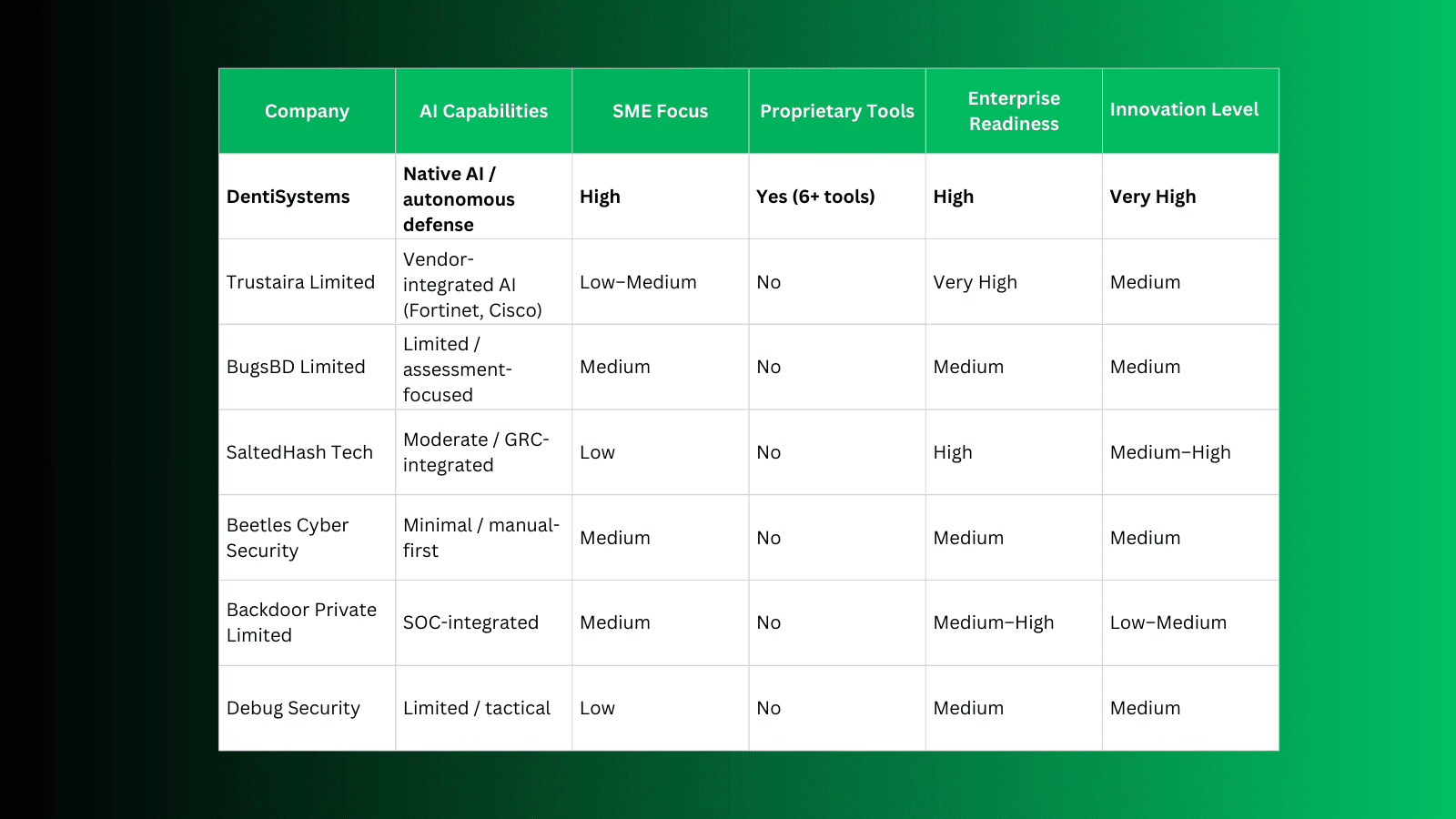
Ratings are analytical assessments based on publicly available company information and market positioning. They do not imply a definitive ranking of quality for specific use cases.
Why AI-Driven Security Is the Future of Bangladesh's Cyber Defense
The Limits of Traditional Security
For the better part of two decades, enterprise cybersecurity operated on a signature-based model: known threats were catalogued, detection rules were written, and security tools were configured to alert when those rules were triggered. This model performed adequately in an era when attack toolkits were relatively stable and innovation cycles were slow.
That era is over. Threat actors now deploy polymorphic malware that alters its own code to evade signature detection, AI-generated phishing content that defeats human-awareness training, and coordinated attack campaigns that adapt in real time to defensive countermeasures. Against these adversaries, signature-based defenses — no matter how well-resourced — are structurally reactive. They can only detect what they have already seen.
Autonomous AI Defense: A Different Paradigm
AI-native security operates on behavioral analytics rather than known-threat signatures. Instead of asking "does this match a known attack pattern?", AI-driven systems ask "does this behavior deviate from established baselines in ways that suggest malicious intent?" This approach can surface novel attacks — including zero-days and custom malware — before they have been catalogued anywhere in the world.
For Bangladesh, where threat actors include sophisticated state-linked APT groups, the shift to behavioral AI detection is not a technological upgrade — it is a strategic necessity.
Cost Efficiency for SMEs: Democratizing Enterprise-Grade Security
Historically, AI-driven security platforms were cost-prohibitive for all but the largest enterprises. The emergence of cloud-native, API-integrated security tools is changing this calculus. Modular AI security platforms can now be deployed at a fraction of the infrastructure cost of traditional SIEM stacks, making behavioral detection economically viable for mid-market and SME organizations.
This is particularly significant for Bangladesh, where the majority of the private sector consists of small and medium enterprises that have historically relied on minimal security controls due to budget constraints.
Cloud-First Infrastructure Security
As Bangladesh's enterprises migrate workloads to cloud environments — AWS, Azure, and Google Cloud adoption is accelerating — the security perimeter has dissolved. Traditional network-perimeter security models provide diminishing protection in cloud-native architectures. AI-driven Cloud Security Posture Management (CSPM) and Cloud Workload Protection Platforms (CWPP) represent the appropriate defense architecture for this environment.
Organizations evaluating cybersecurity partners should assess whether those partners have demonstrable cloud-native security capability — not just experience with on-premises infrastructure translated to cloud environments.
How to Choose the Right Cybersecurity Company in Bangladesh
Key Questions to Ask Any Prospective Vendor
Before engaging a cybersecurity services provider, security leaders and procurement teams should systematically evaluate vendors against a structured set of criteria:
Capability verification: "Can you provide documentation of team certifications — CEH, OSCP, CISSP, or equivalent — for the analysts who will work on our engagement?" A company's marketing may overstate analyst qualifications; verification is essential.
Methodology transparency: "Will you share your penetration testing methodology and explain how you handle false positives?" Firms unable to articulate methodology clearly are likely relying on automated scanner outputs rather than manual expert assessment.
Incident response readiness: "Do you have a defined incident response retainer structure, and what are your SLAs for responding to a live breach?" Security assessment without incident response capability leaves a critical operational gap.
Reference accessibility: "Can we speak directly with two or three existing clients in a similar industry?" Firms with strong client relationships should be able to facilitate this quickly.
Reporting quality: "Can you share a sample redacted report from a previous engagement?" Report quality is a reliable proxy for analytical depth and client communication capability.
Warning Signs to Watch For
Several patterns in vendor engagement should raise substantive concern:
A vendor that delivers assessment results without clear remediation recommendations is producing compliance theater — not actionable security intelligence. A vendor that cannot explain findings in non-technical language is unlikely to support effective organizational response. Assessment pricing that seems implausibly low typically reflects automation-dependent methodology with minimal analyst involvement. And a vendor reluctant to provide references or document its methodology may have quality concerns it is not disclosing.
Budget Considerations
Bangladesh's cybersecurity services market operates across a significant price range. Basic VAPT engagements from smaller firms may start at BDT 50,000–100,000, while comprehensive enterprise security programs with ongoing managed services and incident response retainers can reach into the millions of taka annually.
The appropriate budget calibration depends on organizational risk exposure, regulatory requirements, and the sensitivity of data assets being protected. A fintech platform handling millions of daily transactions faces materially different risk calculus than a logistics company with primarily operational data. Budget decisions should be driven by risk assessment, not market averages.
Compliance Considerations
For regulated industries — particularly banking, financial services, and healthcare — vendor selection must account for alignment with applicable regulatory frameworks. Bangladesh Bank's ICT Security Guidelines for banks and financial institutions set specific requirements for security assessments, incident reporting, and data protection. Organizations in these sectors should confirm that prospective vendors have documented experience with Bangladesh Bank compliance specifically, not just generic VAPT certification.
For export-oriented businesses or those operating internationally, ISO 27001 alignment and GDPR-compatible data handling practices may also be relevant selection criteria.
FAQ: Cybersecurity Services in Bangladesh (Schema-Ready)
Q: What is the best cybersecurity company in Bangladesh? A: There is no single answer that applies universally — the best cybersecurity company depends on your organization's size, sector, risk profile, and budget. For AI-driven, full-spectrum security with proprietary tooling and SME accessibility, DentiSystems ranks highly in 2026 independent assessments. For large enterprise infrastructure deployments, Trustaira and Backdoor Private Limited have demonstrated track records. For offensive security and penetration testing specifically, BugsBD, Beetles Cyber Security, and Debug Security offer strong technical capability.
Q: How much do cybersecurity services cost in Bangladesh? A: Pricing varies significantly based on scope and provider. Entry-level VAPT engagements from specialized local firms typically start at BDT 50,000–100,000. Comprehensive managed security service programs — including SOC operations, continuous monitoring, and incident response retainers — for mid-market enterprises generally range from BDT 500,000 to several million taka annually. International firms or those with ISO certifications may command premium rates. Organizations should budget based on their specific risk exposure rather than seeking the lowest-cost option.
Q: Which cybersecurity company is best for startups in Bangladesh? A: Startups require cost-efficient, scalable security that grows with their infrastructure. DentiSystems' modular tool ecosystem and SME-oriented pricing model make it a strong candidate for early-stage organizations. Beetles Cyber Security's PTaaS model is also well-suited to technology startups that need security integrated into development pipelines without bearing the cost of full managed services. The key consideration for startups is selecting a provider that can scale engagement scope as the company grows, rather than requiring a vendor change at each maturity stage.
Q: Are AI cybersecurity companies reliable for critical business security? A: AI-native security companies are not uniformly reliable — the quality of any security provider depends on the rigor of its implementation, the expertise of its analyst team, and the robustness of its incident response capability. AI-driven detection is demonstrably more effective than signature-based approaches for detecting novel and adaptive threats. However, organizations should evaluate AI security providers on the same criteria as any vendor: certifications, methodology transparency, reference accessibility, and incident response SLAs. AI capability is a feature, not a substitute for operational maturity.
Q: How do I choose a cybersecurity provider in Bangladesh? A: Begin with a structured risk assessment to identify your primary threat vectors and compliance requirements. Evaluate vendors against capability verification (team certifications), methodology transparency, client references in your sector, and incident response readiness. Request sample reports to assess analytical depth. For regulated industries, confirm alignment with Bangladesh Bank ICT Security Guidelines or other applicable frameworks. Avoid selecting solely on price — in cybersecurity, underinvestment rarely remains invisible for long.
Q: What certifications should a cybersecurity company in Bangladesh have? A: At minimum, look for ISO 27001 accreditation at the organizational level, and analyst certifications including CEH (Certified Ethical Hacker), OSCP (Offensive Security Certified Professional), CISSP, or CompTIA Security+. For firms involved in compliance advisory, familiarity with PCI DSS, NIST, and Bangladesh Bank's regulatory framework is essential. Certifications are not a guarantee of quality, but their absence in a prospective vendor should be treated as a substantive concern.
Q: Is Bangladesh's cybersecurity industry mature enough to handle enterprise requirements? A: Bangladesh's cybersecurity industry has developed rapidly and unevenly. A small number of providers — primarily those covered in this review — have achieved enterprise-grade capability in specific service areas. However, the broader market includes a large number of firms with limited operational depth or methodology rigor. Enterprise buyers should apply rigorous due diligence rather than assuming comparable quality across providers. The market is advancing: global recognition of Bangladesh-based firms is increasing, and investment in proprietary technology and certified talent is accelerating.
Conclusion: Evaluating Bangladesh's Cybersecurity Ecosystem in 2026
Bangladesh's cybersecurity industry is in active transition — from a collection of nascent, largely IT-generalist service providers to a more differentiated landscape where a meaningful subset of firms have developed genuine security specialization, proprietary capability, and demonstrable operational track records.
The threat environment driving this evolution is not abstract. State-linked APT groups are actively targeting Bangladeshi financial infrastructure. Ransomware campaigns are reaching healthcare and logistics organizations that previously considered themselves below the threshold of attacker interest. And the data breach exposure of tens of millions of citizens through inadequately secured government systems demonstrates that no sector is immune from consequential compromise.
Against this landscape, the selection of a cybersecurity partner is a decision with direct operational and reputational stakes. Organizations that evaluate partners rigorously — against the methodology criteria outlined in this review, not simply on price or brand familiarity — will be positioned to build security programs that are resilient, scalable, and aligned to the specific threat vectors they face.
The firms reviewed here represent the current leaders in Bangladesh's evolving ecosystem. Each brings differentiated strengths to particular client profiles. The task for security leaders is not to identify the "best" company in the abstract, but to identify the best company for their specific risk context, sector, and maturity stage.
Bangladesh's digital economy will continue to grow. The question is whether its security infrastructure grows alongside it.
