

The way organizations pay for cybersecurity has been broken for a long time. Tiered subscription plans assume every client's threat environment looks the same. It doesn't. And DentiSystems has decided to stop pretending otherwise.
Effective today, DentiGrid — DentiSystems' flagship AI-powered cyber defense platform — retires the Free/Pro subscription model entirely. In its place: a fully configurable, Node-Based Autonomous Defense Architecture that maps security coverage directly to a client's real attack surface. Not a vendor's assumption of it.
This is not a version update. This is a new model for how enterprise AI security gets built, deployed, and charged for.
Why Subscription Tiers Had to Die
Subscription tiers work well for SaaS productivity tools. They work poorly for cybersecurity — because cybersecurity is not a feature set. It is a defense posture, and defense postures are unique to the infrastructure being defended.
A startup running a single cloud server faces a fundamentally different threat surface than a multi-region enterprise with thousands of daily authentication events, distributed databases, and high-volume web-facing APIs. Charging both from the same pricing page, and calling it "Pro," is security theater.
Under the old model, smaller organizations overpaid for attack vector coverage their infrastructure never faced. Larger organizations hit tier ceilings and either paid enterprise rates for excess capacity — or worse, under-deployed and left real gaps in their coverage. Both outcomes are unacceptable.
The New Philosophy: "Pay for your Surface Area — not a Tier." Every node a client deploys is a direct, measurable, and intentional layer of AI defense. There are no unused features, no arbitrary feature gates, and no coverage decisions made by a pricing team. Security architecture is determined by the client's actual infrastructure — full stop.
What Is a DentiGrid Node?
A DentiGrid Node is a dedicated, autonomous AI defense unit — an independent security agent engineered to detect, analyze, and neutralize one specific class of cyber threat. Nodes operate autonomously within a client's grid while simultaneously sharing real-time threat intelligence with adjacent nodes, forming a synchronized, self-reinforcing security mesh.
Each node is purpose-built. It does not try to monitor everything. It monitors one attack vector — and it does it at a level of precision that a generalist security layer cannot match. This specialization is what makes the grid dangerous to attackers and efficient for the clients deploying it.
Active Node Specializations
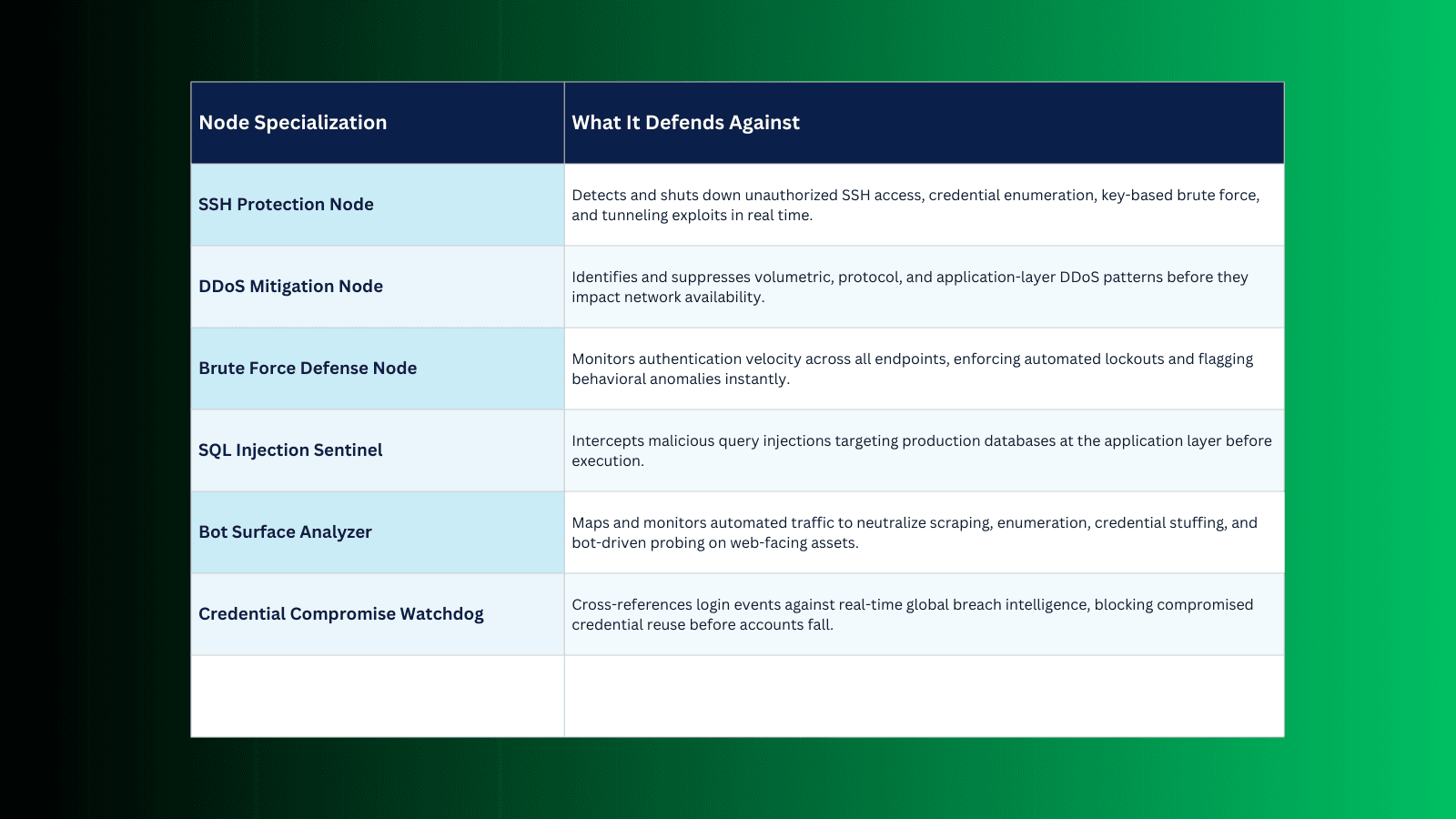
The DentiGrid node library is continuously expanded as the threat landscape evolves. New node specializations are released on a rolling basis, and all active clients receive access to new nodes as they become available — without renegotiating their deployment contract.
Custom-Based Security: Your Grid, Your Architecture
No platform, no vendor, and no subscription plan can pre-define what your infrastructure needs to be secure. The size of your attack surface, the complexity of your database architecture, the volume of your API traffic, the number of authentication events your systems process daily — these are the variables that should determine your security posture. Not a pricing tier.
When a client onboards to the new DentiGrid model, they work directly with the DentiSystems team to complete a Security Surface Assessment — a technical mapping of their environment to a recommended baseline node configuration. The output is a bespoke defense grid: purpose-built, precisely scoped, and owned by the client's actual risk profile.
How the Grid Scales With Your Infrastructure
Lean Infrastructure / Early-StageA 5-node baseline grid covers the core attack vectors most likely to target smaller deployments: SSH protection, brute force defense, DDoS mitigation, SQL injection monitoring, and bot surface detection. Complete, coordinated, and cost-efficient.
Scaling Operations / Mid-MarketAs API surface area expands, transaction volume grows, and infrastructure becomes more distributed, additional nodes extend coverage into advanced credential monitoring, cross-endpoint anomaly correlation, and traffic pattern analysis.
Enterprise / High-Complexity Infrastructure21+ node deployments deliver full-spectrum coverage across complex, multi-region architectures. At this scale, DentiGrid's cross-node AI intelligence sharing creates emergent detection capabilities — identifying coordinated multi-vector attacks that no single node could flag independently.
Flexible Scaling: Pricing That Rewards Full-Grid Security
DentiGrid's commercial model is built around a simple principle: the more committed a client is to comprehensive security, the more favorable their per-node rate. Volume discounts scale automatically as node count increases — incentivizing clients to build the full grid their infrastructure demands, not the minimum they can get away with.
Node Deployment Tiers
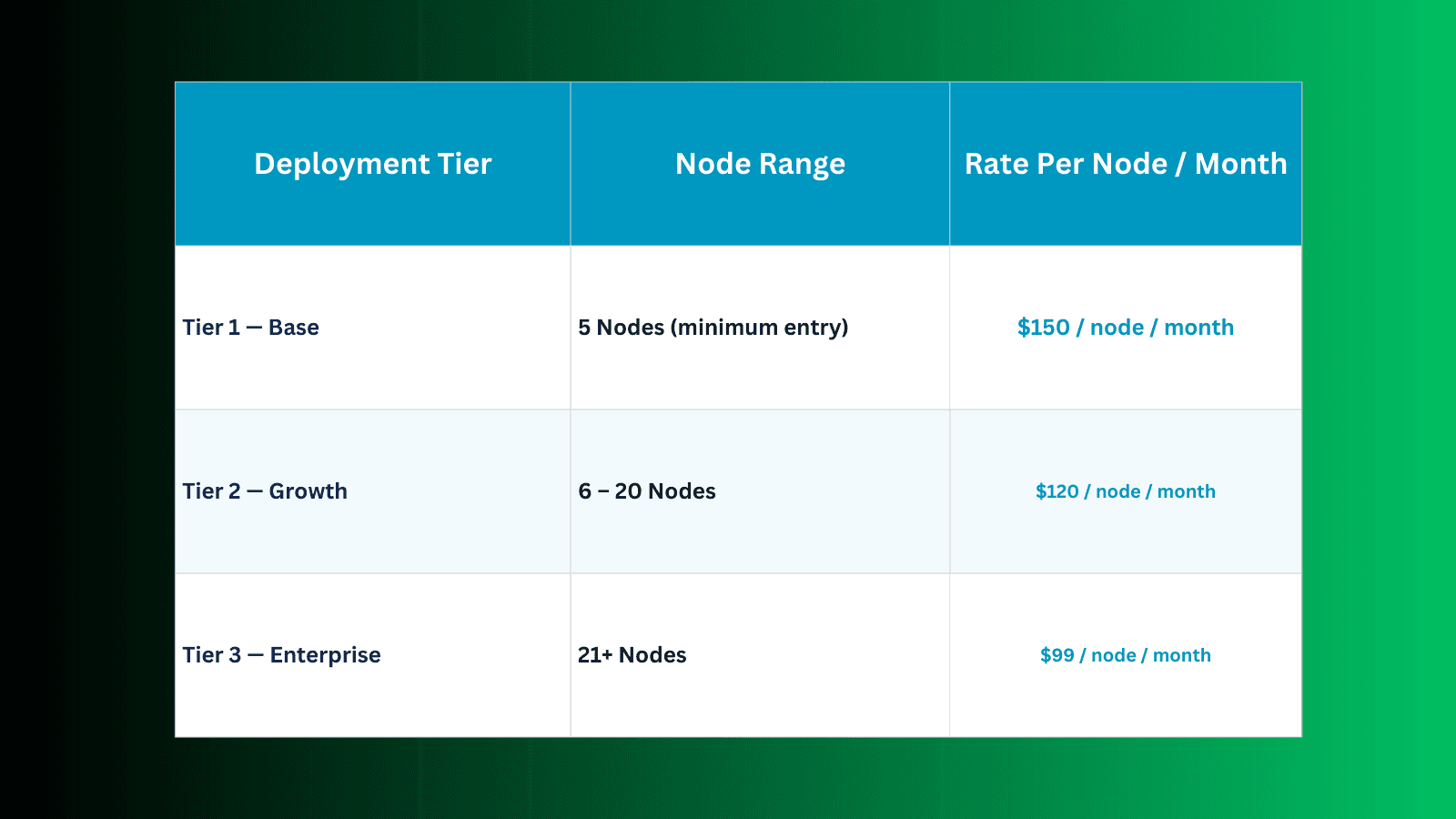
All rates are billed monthly per active deployed node. Node count can be adjusted at any time — scaling up or down as infrastructure requirements change. Tier reclassification is applied automatically at the next billing cycle with no manual intervention required.
Why Is the Minimum Entry Point 5 Nodes?
A single node is a monitor. Five nodes is a mesh. DentiGrid's AI architecture is designed for interconnected operation — nodes share threat intelligence, validate each other's anomaly flags, and coordinate responses to multi-vector attacks. Below 5 nodes, the system cannot establish the data density required for AI efficacy or the lateral coverage required for mesh integrity. The 5-node minimum is a technical requirement, not a commercial one.
For Existing DentiGrid Clients
Every client currently on a DentiGrid subscription plan will be contacted directly by their DentiSystems account representative within the next 14 days. Each client will receive a complimentary Security Surface Assessment, with a personalized node configuration recommendation based on their current infrastructure and threat environment.
Migrations are zero-downtime. Existing protection remains fully active throughout the transition window — there is no gap in coverage at any point during the switch to the node-based architecture.
Clients who complete their migration within the first 30 days are given priority access to new node specializations as they are released from the DentiGrid development pipeline.
Security That Fits. Coverage That Counts.
The cyber threat landscape does not respect subscription tiers. Attackers don't adjust their methods based on what plan their target is paying for. Defenders shouldn't have to either.
DentiGrid's node-based model gives security leaders — CISOs, CTOs, and infrastructure owners — a level of clarity and control that flat-rate plans were never designed to provide. You know exactly what you're deploying. You know exactly what each node is defending. And you know exactly what you're paying for it.
No feature bloat. No arbitrary coverage caps. No paying for a tier when what your infrastructure needs is a grid.
Build Your Grid — Start With a Security Surface Assessment Contact your DentiSystems account representative or visit denti.systems to begin your Security Surface Assessment. Our team will map your infrastructure, scope your node configuration, and deploy your grid — with no downtime and full coverage continuity from day one.
